Is Perfume safe to use? Perfume is generally safe provided that brands use formulations which follow IFRA guidelines. Most safety concerns relate to skin sensitivity or allergens rather than serious health risks. However, perfume is not just about ingredients, it also depends on stability, packaging and how a perfume performs over time.
For brands safety is about more than compliance.
It is a design decision, a trust signal and a long term asset.
Understanding how perfume safety works across formulation, regulation and packaging is vital for brands. This allows them to not only perform consistently, but to build brand credibility.
What does Perfume Safety actually mean?
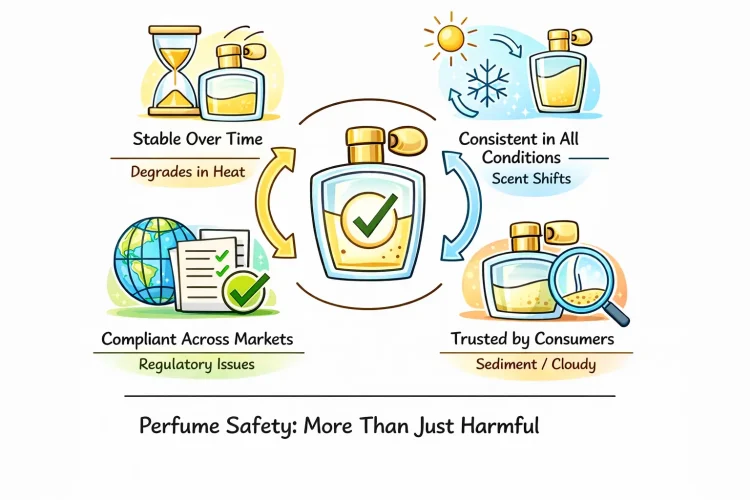
Perfume safety isn’t just about whether it is harmful, it is also about whether:
- a fragrance is stable over time
- it is consistent over different environments
- the fragrance is compliant across markets
- the perfume is trustworthy to the end user
All of this matters, as a perfume may be technically safe, but still:
- degrade in high temperatures
- shift in scent due to ingredient interactions
- show sediment in the perfume
- lose consumer trust due to unclear labelling
Understanding Perfume Safety Regulations
Europe
In Europe perfume safety regulation follow IFRA (International Fragrance Association) and REACH (Registration, Evaluation, Authorisation and Restriction of Chemicals). IFRA sets guidelines on chemical usage, concentration limits and safety practices. You may use more of certain chemicals depending on how much exposure there is to the skin. For example, rinse off formulas such as shampoos do not stay long on the skin, so we use a higher ingredient percentage than for a skin cream. REACH relates to identifying risks of certain chemicals during manufacture and shipping, ensuring safety of any hazardous materials.
GCC and UAE
Brands are increasingly aligning with European and IFRA perfume regulations. Gulf countries do not have a legal obligation to follow European legislation, however if they wish to export to Europe they must be compliant. For import into Saudi Arabia brands must follow the fragrance legislation of the Saudi Food and Drug Authority (SFDA). Prior to shipping to Saudi Arabia brands should apply for a certificate of conformity, as well as ensuring that they have Arabic compliant labelling.
USA
In the USA the FDA or Food and Drug Association regulates perfumes under cosmetics rules. Brands are responsible for safety and can be held liable in case of problems. The USA recently introduced MOCRA legislation ‘Modernisation of Cosmetics Regulation Act’ which brings the standards closer to Europe. However, the big difference in the USA is that it is not necessary to mention allergens, as you only have to show the concentration level : for example eau de parfum or eau de toilette.
If brands want to sell world wide, then it is easier to develop one formula for the whole world which is compliant for all markets. This is why most brands choose to follow the European IFRA guidelines for fragrance development which are stricter. Perfume safety regulations are not universal, they are market specific, so you must be aware of where you plan to sell.
Why Perfume Safety is part of the Branding Decision
Safety is rarely seen, but it is felt, thus a consumer knows when trust has been earned. Today’s consumers are more aware of the importance of :
- ingredient transparency
- ‘clean’ or more conscious formulations
- product integrity over time
This does not mean that every perfume needs to be clean, but it does mean that trust is part of the product experience.
In this way, perfume safety becomes less about avoiding risk and more about brand credibility.
Can Perfume Affect Your Health?
We hear many stories about perfume safety and how it is bad for your health and how it often contains endocrine disrupting chemicals. Let’s address this issue from a scientific perspective in order to gain some more clarity.
- Most perfumers worldwide follow IFRA guidelines which advise which chemicals can be used and the dosage level which is safe
- IFRA has lists of banned chemicals which perfumers should not use as well as pinpointing known allergens. Allergens are chemicals which can cause a sensitising reaction to the skin. For known allergens, perfumers will dose the ingredients in the fragrance at a safe level below the sensitising level. Furthermore they advise what is the maximum advisable percentage of oil which should be used in the final perfume to avoid causing an allergic reaction.
Why Perfume Ingredients and Dosing is Important
- Synthetic ingredients are not less safe than natural ingredients, as a molecule is a molecule, whether is is plant derived or made in a laboratory. Often synthetic ingredients can be safer because their sensitising elements have been removed in the laboratory. Some known natural ingredients such as oak moss are known allergens and therefore are not allowed in perfumes nowadays.
- Perfume safety depends on the dose of the ingredients within it, as even water can be irritating to the skin at large doses. This is why IFRA regulates the dosing of ingredients, not whether it is synthetic or natural.
- Perfume safety also is related to skin absorption and how long a chemical stays on the skin. Mostly perfumes are applied to the skin, but most of the perfume evaporates soon after spraying. Only a very small percentage of the formula goes into the bloodstream, a fraction of the amount which would be considered a worry to your health or hormone safety.
- Fragrance ingredients are evaluated by IFRA, EU SCCS and other regulatory bodies. For this reason, if something really posed a threat to health, or disrupted the endocrine system, it simply would not be allowed.
- Laboratory tests which show endocrine disruption show doses of ingredients at far higher levels than those which IFRA allows. More realistic risks are skin sensitivity, photosensitivity and allergic reactions such as redness or itching.



The Role of Packaging in Perfume Safety
One of the most overlooked aspects of perfume safety is packaging. While formulation is regulated, packaging determines whether a perfume remains stable, consistent and safe throughout its lifecycle. Although packaging plays an important role in perfume safety, it may not be obvious at first view. Fragrance is not isolated, as it comes into direct contact with the packaging components.
Material choices can affect :
- Stability : Certain plastics may crack when perfume and alcohol comes into contact. Furthermore, certain coatings may not withstand heavy oils and concentrated formulations. Internal lacquer in a perfume bottle may peel off if the formulation attacks the coating and there has been insufficient testing prior to manufacture.
- Longevity : Exposure to air, light and heat can affect formulations to accelerate degradation.
- Consistency: Variations in packaging, whether they are colour variations or size differences, for example plastic shrinkage variances.
- Suitability for Use: You must think carefully of how the product will be stored and also displayed. What will be the retail environment and how does this affect your packaging? In many stores UV light can rapidly age the colours in your perfume boxes, bleaching them badly.
- Structure and fitment: Poorly fitted inserts, weak closures, poor quality glue in caps and the wrong locking system can all affect product integrity.
- Sustainability: Increasingly, brands are evaluating these decisions through a sustainability lens, simultaneously balancing environmental responsibility with performance.
Packaging is not just protective, it is part of the product’s performance system. Any failure to perform will affect brand credibility.
Designing for Real World Conditions
A fragrance is rarely experienced in ideal conditions. Fragrance moves through:
- Homes with variable conditions and climates
- warehouses
- shipping containers
- transportation by road
Each stage involves different variables, especially in regions where there are differing levels of heat and humidity.
It is important to select materials that withstand environmental stress and design structures that maintain integrity during transportation. Good branding ensures product consistency from production to unboxing. Perfume safety in the real world means designing a product that withstands all the environmental pressures from the factory up to the consumer’s home. Brands owners who do not account for this early on face subtle but costly issues :
- Packaging deformation
- Changes in scent profile
- Reduced shelf life
FAQs of Perfume Safety
- What is the IFRA Fragrance List?
It is a list of safe and unsafe ingredients, as well as a list of compounds which should be dosed at a lower level to avoid sensitivity. - How Should I avoid Skin Sensitivity with my perfume?
Always patch test your new perfume on your skin for 24 hours if you are prone to sensitivity. Avoid over applying perfume. - How do I know if my perfume could cause an Allergic Reaction?
Read the list of ingredients in your perfume. In many countries known allergens must be mentioned as part of the ingredient list. The fact that an allergen is mentioned does not mean that it will necessarily give an allergic reaction to you. The perfume oil should contain less of the ingredient than the level at which it causes an allergic reaction. - Are Perfumes Toxic to Humans?
Any chemical in the wrong dose can be toxic to a Human Being. Provided that the IFRA guidelines are being followed, there is no risk of toxicity, though in isolated cases there may be skin sensitivity. Perfume should never be ingested, it is only for external use. - How should I list my perfume product ingredients?
Normally ingredients are listed in order of the highest percentage content. All allergens mentioned on the material safety data sheet from the supplier should be mentioned in your ingredient list. - What is a material safety data sheet?
It is a data sheet supplied by fragrance oil manufacturers who list all of the allergens in a perfume. It specifies how much of the ingredient is in the formulation and makes a recommendation to the buyer to dose the product below a certain amount. This avoids the creation of a product which could give an allergic reaction. - Why has IFRA banned some chemicals?
IFRA has conducted extensive scientific research to know the effects of all perfume compounds. Research is regularly updated and this IFRA sometimes bans new chemicals, both synthetic and natural oils. IFRA restricts or bans anything which can cause toxicity, allergic reaction, or is known to be a carcinogen or known to be non-biodegradable.
What Luxury Brands Get Right
Luxury brands don’t talk specifically about product safety, but they design for every small safety detail. They always:
- work within regulatory frameworks
- invest in material quality and consistency
- invest in strict quality control and goods inspections at all stages of production
- ensure that all touchpoints of the perfume design support brand integrity
Final Thoughts: Perfume Safety as Part of the Product Experience
For brands who get it right, perfume safety is more than just a tickbox to be checked. It influences how a brand performs over time and how it is perceived by clients. Furthermore these brands travel scale seamlessly across global markets, delivering a consistent product experience. Brands who approach safety as part of the design, not just regulation, are the ones who create perfumes which endure, both physically and reputationally.
At Anisha we partner with fragrance brands to ensure packaging is not just visually compelling but engineered for product safety, consistency and global compliance. If you’re looking to develop perfume packaging which performs as well as it presents, get in touch with us to explore how we can support your next project.